What Do Boys Get?
May 15, 2011
When I was about ten years old my breasts started to develop. They were tender lumps on my chest. When I told Mama that I had sore lumps on my chest she marched me right up to Jo Voller’s house.
Jo was the oldest mom on the street. She had five children, four of them girls. She was a breast cancer survivor and she was menopausal. I stood in her kitchen, a kitchen I visited frequently while playing with the two youngest girls, Terri & Debbie; but this time I was alone with Jo and Mama. Jo asked me to lift my shirt and she gently, yet firmly, touched my growing buds and in a quick moment assured Mama that I was developing normally.
As my breasts grew Mama avoided buying me a bra and I avoided asking for one. Terri, who was two years older, had a training bra. I suppose she was training herself to wear one because there was nothing there to support.
I always knew my parents were growing up along side us kids – they were kids themselves when my brother was born. Mom was straightforward and honest with us, forging new territory in honest discussions of human development. She checked out a book from the library with collaged illustrations for our talk about where babies come from.
When I got my period she gave me a pearl ring – my birthstone is a pearl. When my period came I was so excited and proud. For the year before, every time I got a stomachache I wondered if my period was coming. There was no stomachache or cramps, it just showed up in 7th grade following my first teen party and my first slow dance.
As a single woman in New York I worked at a small location scouting agency. Cece and I forged a close friendship over the years at work sitting next to and across from each other in the small office. We dissected our lives, compared and contrasted our development, our relationships. Cece and I are both middle children – she has two brothers. I have an older brother and a younger sister.
When Cece’s mom told her about where babies come from she briefly described the unfortunate circumstances that would make appearances monthly and devastate most of her life. She took it in and asked her mother “What do the boys get? If I have to have this, what do the boys get?” She was distraught.
Several years later, pregnant with my third baby, I am having dinner with my two girls, Phoebe, nearly ten years old and Chloe, 4. Rob is out for a business dinner. It is a girl’s night. Phoebe tells me her breasts are feeling tender and lumpy. I go to the bookshelf and whip out my latest copy of Our Bodies, Ourselves. There is a lovely illustration of the different stages of breast development. We discuss the development of girls and women’s bodies. They have watched my belly grow, they have both been nurtured at my breasts.

It is a school night, dinner is over and it is shower time. We go together to the bathroom. I turn on the shower, the girls get undressed and Phoebe looks at her nude body in the mirror and says “It is so cool! We get to feed babies with our breasts. We get to grow babies on our bodies. What do boys get? They don’t get to do that!”
The girls get into the shower and I “Yes!” myself for doing a good job. Then I weep that Mama is no longer around for me to call and tell her what I learned from her.
Bye Bye Breast Burka
March 23, 2011
Some of you have seen this but it bears showing from time to time: 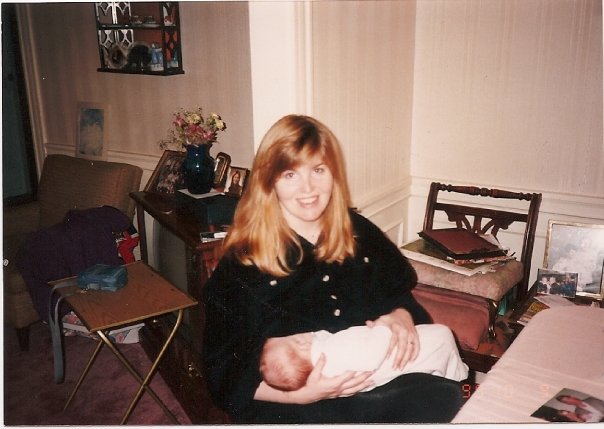 Katherine, a new mom, called me to discuss her milk supply. She was concerned with keeping up the demand of her baby. Then she asked me other breastfeeding questions. She was not sure how to nurse Sadie outside of her house. She thought it was because she needed her “special pillow.” The truth is she doesn’t know how because few women really breastfeed in public anymore. There was an orangutan at a zoo in Boston. The zookeepers mated her and she became pregnant. Ms. Orangutan had been raised in captivity. She had not lived among sister orangutans so she did not know what to do with her baby when he was born – the baby orangutan died. The second time around the zookeepers asked volunteers from the local chapter of La Leche League to nurse their babies in front of the primate. When the second baby was born the primate placed her baby in her arms backwards but with some guidance from the staff quickly learned to feed and care for her baby. This is how we learn. We observe the behavior of others. When I was a pregnant with my first baby I had met a few breastfeeding mothers along the way including my sister-in-law. I took a breastfeeding class to learn as much as I could before my baby arrived. When Phoebe was born she was placed in my arms and we nursed for the first time for about twenty minutes. And then we nursed – a lot. I felt awkward. I fumbled to unlatch my nursing bras, some of which were too big, some of which were too tight and one that broke. I bought dowdy nursing clothes. I wore button shirts. I still felt awkward. Phoebe was born on a hot summer day. I am a gregarious person. I am best chatting with a group. As a new mother I felt isolated. I hungered for company That summer we had a few social events – a wedding, an engagement party – “showing off our baby” weekends. I noticed that wherever I went the host always had a “nice air conditioned room with a comfy chair” for me to go and nurse Phoebe. And Phoebe nursed all the time. I was even isolated in my socialization. Sandra, my brother’s wife had recommended attending a La Leche League meeting. The meetings had been a great resource for her as a new mom. I found the meetings helpful but even more important were the lunch dates after the meetings. Phoebe and I joined other nursing moms monthly at the Thruway Diner. We always sat at the big round table in the center of the bustling eatery. Six to ten moms and their babies smack in the middle of business suits, ties, skirts and silk blouses. This is where I learned to nurse out and about with confidence. I watched the moms with older babies. I saw unspoken communication between them. I saw how a baby might start to wiggle a bit and like Houdini the mom had unhooked her bra, lifted her shirt and latched the baby in seconds flat. It looked effortless and it also looked like there was a baby in her arms – no breasts hanging out, no cover ups – simply a babe in arms. I wanted to be like them. I wanted to feel that assured. I wanted to look that smooth and at ease. As I expressed my envy at their mastery they all assured me that they too had been awkward. They encouraged me to nurse Phoebe in front of a mirror and I did. I grew confident in my ability to nurse Phoebe whenever she needed. At the next social gathering Phoebe started rooting and I said to Rob, “I am going to nurse her here.” He put his arm around me and kept talking. From there I declined offers for the “air conditioned room with a comfy chair.” I eventually became a La Leche League leader and then lactation consultant. I gave birth to two more children. I nursed them all over the place: the bus, the subway, Saks, Barnes & Noble, fancy restaurants, diners. Usually no one except other mother’s knew I was nursing. I was not hiding behind anything just nursing my babies. When my youngest child, Finn, was about 6 months old I was at the pediatrician’s office for a well check up. In the waiting area were two new moms discussing a new product they had just discovered – “The Hooter Hider” one of them said in an embarrassed giggle. Then I started seeing breastfeeding covers everywhere. This was the antithesis of the Thruway Diner experience. A baby begins to fuss, the mother searches her bag for the cover, the baby fusses more, the mother opens the cover, ties it around her, by now the baby is wailing, the mom fumbles with the cover and the baby, the baby kicks about, perhaps not wishing to be under a tent. Now everyone knows what is going on under the fabric. How challenging this makes everything. Breastfeeding by its very nature is designed to be simple. We have complicated it. We have made it shameful and difficult. Like the orangutan new moms today have no real life positive breastfeeding images. Courtney, another new mom, asked me a question about nursing in public. I asked her, “ Do you have any friends who are breastfeeding?” “Yes,” she replied. “So go hang out with them, learn from them,” I offered. “They use a cover or expressed milk in a bottle.” she answered. “Go to the thruway diner!!!” I want to scream. But that was another time, another place. I walk down the street and look into the windows of Victoria’s Secret, American Apparel and Abercrombie + Fitch – this is our provocative world yet we must put a tent around us to feed our babies? We flaunt our breasts to sell products. Breasts are sexy – until they become functional. Then we hide them. A few years ago I could spot a breastfeeding mom because I had a keen eye and I had been there. Nowadays anyone can tell a breastfeeding mom – she is the one hiding behind the overpriced piece of calico.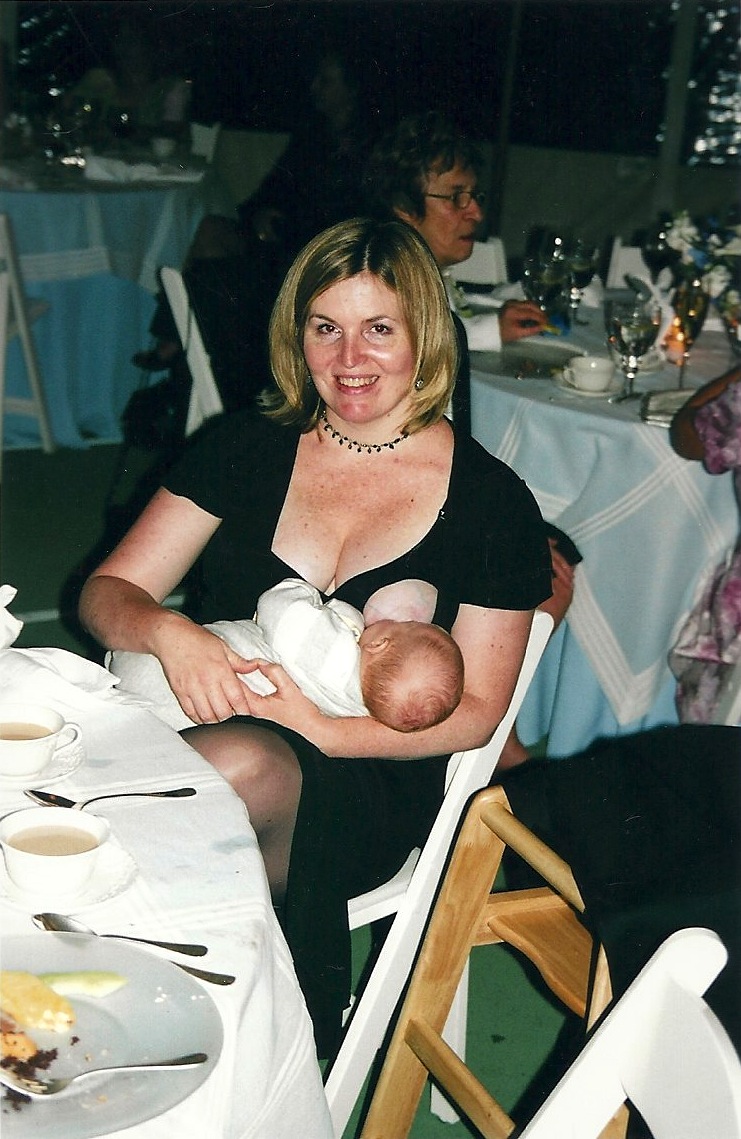
Migrant Mother at MoMA
March 9, 2011
I took a trip with Chloe’s 4th/5th grade class to the Museum of Modern Art. They are studying heroes – everyday heroes. Brandon, one of Chloe’s classmates quickly pointed out that moms are heroes. He loves his mom. He told me, “Moms work really hard all day long but they make it look easy.”
Our MoMa tour guide, Grace, took us through the Museum. It was Tuesday, which is the day MoMA is closed to the public. It was so great to see the amazing art without crowds. Grace took us to the gallery to see Van Gogh’s Starry Night. It was truly breathtaking.
We saw Andy Warhol’s Gold Marilyn Monroe, Picasso’s Girl in the Mirror and the beautiful sculpture Unique Forms of Continuity and Space by Umberto Boccioni.
The most moving exhibit for me yesterday was Dorothea Lange’s photographs of the Great Depression. We focused on Migrant Mother. Grace asked the children to comment on it and share their observations. They noted her pained look into the distance, they noted the determination in her expression, they noted the children on either side of her. I was proud that Chloe noticed the baby in her lap – it is not so obvious. I noticed the baby looked full faced, well fed. I asked Chloe if she knew why the bay looked healthy when the others looked thin. She rolled her eyes and let out a sigh and said, “because she nurses him.” Grace looked over at us. I shared my observation of the full faced baby and Grace commented, “well, yes, the mother is determined to get her children fed.” I said, “the baby is clearly breastfed.” Grace looked at me askance. I smiled. We moved on.
I was so moved by the exhibit and this photograph. I went home and googled Dorothea Lange and Migrant Mother. The Migrant Mother is Florence Owens Thompson. I will not get into the controversy surrounding the photos of Mrs. Thompson but I did find that Dorothea Lange took a few other images of her. There is a beautiful image of her nursing the baby.
Go to the MOMA.

 mamamilkandme